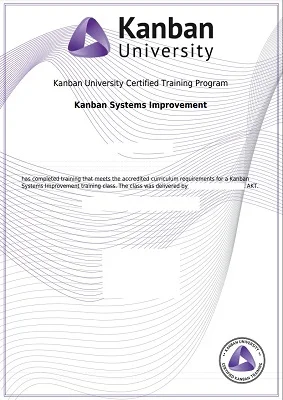
Kanban Systems Improvement (KSI) course concentrates on the complex demands of a multi-teamed organization and explores how to maintain momentum beyond initial improvements realized from a successful Kanban implementation.
Countries worldwide
Expert Trainers
Professionals Trained
Overall Rating
The Kanban Systems Improvement Training course is a sequel to the KMP1 course providing students with insights into the implementation and operation of a Kanban system. We not only help you build your Kanban knowledge but also take your Kanban implementation to a new level.
This 2-day course is a combination of various exercises, simulations, and workshops along with instructor-led discussions and presentations to enhance the Kanban method through pull systems, queuing theory, and flow.
Managing Evolutionary Change and Introduction to Kanban Maturity Models.
Dealing with Resistance to Change, Feedback Loops, and Continuous Learning
Implementing and Scaling Kanban across Organization
Balancing Demand and Capability
Optimizing Flow and Predictability
Live Online
Schedule: 09:00 AM 02:00 PM (EST)
Live Online
Schedule: 09:00 AM 05:00 PM (EST)
Live Online
Schedule: 09:00 AM 02:00 PM (EST)
Live Online
Schedule: 09:00 AM 02:00 PM (EST)
Live Online
Schedule: 10:00 AM 06:00 PM (EST)
Live Online
Schedule: 10:00 AM 06:00 PM (EST)
Similar to a KMP 1 certification, there is no specific exam to earn the KMP 2 certification. However, a student needs to attend the entire training session and complete all given assignments.
The courses KMP 1 or Kanban System Design and Team Kanban Practitioner prerequisites.
Happy learners and successful teams, that’s how we measure our impact. Here are just a few of the many who’ve trusted AgileFever.
A Kanban Management Professional 2 certification is the second course after Kanban System Design (KMP I) to attain a Kanban Management Professional credential. Also known as Kanban System Improvement, this course is designed for managers or individual contributors to achieve the following organizational goals:
The Kanban Management Professional course is an alternative path to agility, allowing managers and other individual contributors to effectively build and operate a Kanban system. It is a 5-day course series consisting of Team Kanban Practitioner, Kanban System Design, and Kanban System Improvement courses.

Kanban Key Metrics are Cycle time, Lead Time Distribution and Flow Efficiency.
Kanban is an alternative approach to agility. It focuses on service orientation and creating the service “fit for purpose” by applying principles and practices of Kanban.
Kanban board in JIRA is the visual representation of the flow of work or workflow stage.
Kanban is a method that consists of 3 Service Delivery Principles, 3 Change Management Principles, 3 Scaling Principles and 6 General Practices.
Kanban and Scrum are both ways to achieve business Agility. Kanban is a method or set of practices while Scrum is a Framework, both of which follow Agile Methodology. The approach is different. More differences are discussed in the video here Kanban vs Scrum Webinar and info in the article https://www.agilefever.com/kanban
Kanban follows the lean management approach towards creating business agility.
Kanban is a signaling method that creates a pull based system. It helps you manage the flow of work by limiting WIP. It helps you to visualize the work, identify delays and bottlenecks and improve continuously. A real-life example of Kanban can be seen in Starbucks Coffee Shop. The Cashier pulls in the new customer as soon as they are free. The coffee maker caters to the placed orders as soon as the coffee machine is free.
Kanban works on a pull method. It helps you limit WIP. As soon as the work in any workflow stage goes below the WIP limit, it signals the proceeding stage and pulls in more work in their queue. Kanban system helps visualize the several workflow stages. The visualization helps the team to identify bottlenecks, optimize the flow and continuously improve.