Home AI and Data Science Data Science and Machine Learning with Python

Data Science and Machine Learning with Python

Enrolled 4.9/5 4.6/5 4.8/5

With the help of our extensive Data Science and Machine Learning course, turn unprocessed data into useful insights. This practical curriculum, which builds your knowledge from the bottom up, integrates statistical analysis, programming, and AI basics, making it ideal for aspiring data professionals.

  • 40 hours of live instructor-led training
  • Hands-on projects with real datasets
  • Industry-relevant case studies
  • Interactive coding sessions
  • Advanced analytics techniques
  • Career guidance and portfolio building
View Schedule Download Brochure

Get Free Consultation

    50+

    Countries worldwide

    100+

    Expert Trainers

    10k+

    Professionals Trained

    4.7

    Overall Rating

    Course Overview

    This course covers Introduction to Data Science, Data Mining and Machine Learning, Their Applications, Future Scope, Data Science Process Flow, Statistics, Predictive Analytics, Classification, Clustering, Regression, Exploratory Data Analysis, Machine Learning Algorithms such as Linear Regression, Logistic Regression, KNN, Naive Bayes, Decision Trees, Random Forest, and Evaluation Metrics. Text mining, text analytics, and an introduction to natural language processing are also covered. POS Tagger, NER Tagger, and TF-IDF are some of its uses. All principles are implemented practically in Python. Resolving end-to-end data science issues and business use cases.

    Key Highlights

    Get Practical Hands-on Python with Machine Learning

    Learn Business Use cases

    Discussion on Features for different problems

    Hands-on TF-IDF implementation

    Implementation of Text Mining in Python

    Data Science and Machine Learning with Python Course Content

    Download Syllabus
    Module 1 Introductory Session
    • Analytics Buzzwords – Data Science, Big Data, Analytics, BI, Machine Learning, Hadoop
    • Applications of Data Science / Usage of Data Science
    • Real-Life Examples
    • Future of Data Science in terms of Job Opportunities
    • Comparison of Job Role in Data Science
    • Data Science Process Flow (Descriptive, Predictive, Prescriptive)
    Module 2 Data Science Technology Stack - Python & R
    • Introduction to Python for Data Science
    • Python Basics
    • Python Lists
    • Python Functions and Packages
    • Python NumPy
    • Hands-on Python -Importing various data science packages
    Module 3 Introduction to Machine Learning
    • Applications of Machine Learning
    • Types of Machine Learning (Supervised & Unsupervised)
    • Problem Identification – Classification & Clustering
    • Approach to Solving Data Science Problem
    • Introduction to Python with Machine Learning
    • Introduction to Python for Data Analysis
    • Python Libraries and Data Structures for Data Science
    Module 4 Exploratory Data Analysis using Pandas
    • Practical – Hands-on Python with Machine Learning
    • Univariate Analysis
    • Bivariate Analysis
    • Scatterplot, Barplot, Boxplot
    • Outliers Detection
    • Data Preprocessing – Handling Missing Values, Outliers, Data Cleaning
    Module 5 Statistics for Data Science
    • Gaussian Distribution
    • Correlation and Covariance
    • Hypothesis Testing
    • Feature Engineering
    Module 6 Introduction to Machine Learning Algorithms
    • Regression Vs Classification
    • Linear Regression, Logistic Regression, KNN, Naive Bayes
    • Tree Based Modelling Algorithms – Decision Trees, Random Forest, Ensemble, Bagging, Boosting
    • Cross Validation
    • Evaluation Metrics – RMSE, Accuracy, Confusion Matrix, ROC
    • Implementation of ML Algorithms in Python
    Module 7 Introduction to Unsupervised Learning
    • Introduction to Clustering
    • K-means Clustering
    • Implementation of K-means clustering in Python
    Module 8 Introduction to Natural Language Processing
    • Introduction to Text Analytics
    • Steps of Text Mining
    • POS Tagging
    • NER Tagger
    • TF-IDF Model
    Module 9 Implementation of NLP in Python
    • TF-IDF implementation
    • Implementation of Text Mining in Python
    Module 10 Solving end-to-end data science problems
    • Business Use cases
    • Discussion on Features for different problems

    Schedules for Data Science and Machine Learning with Python

    Enquiry for Corporate Training

      I consent to AgileFever representative contacting me.

      Talk to a Learning Advisor

      To fast-track your career and achieve

      Can't find Convenient Schedule?

      Pay Monthly EMI, as low as

      $75/month
      We have partnered with the following financing companies to provide competitive finance options at as low as 0% interest rates with no hidden cost.
      payment

      Data Science and Machine Learning with Python Exam Details

      Exam Details

      Name of Exam – AgileFever Data Science and Machine Learning with Python Examination

      Exam details are as follows:

      • Practical Exams, Lab Assessments, and Projects at the end of every completed module.
      • Capstone Project at the end of the 40-hour training.
      Prerequisites

      Anyone can register to this course.

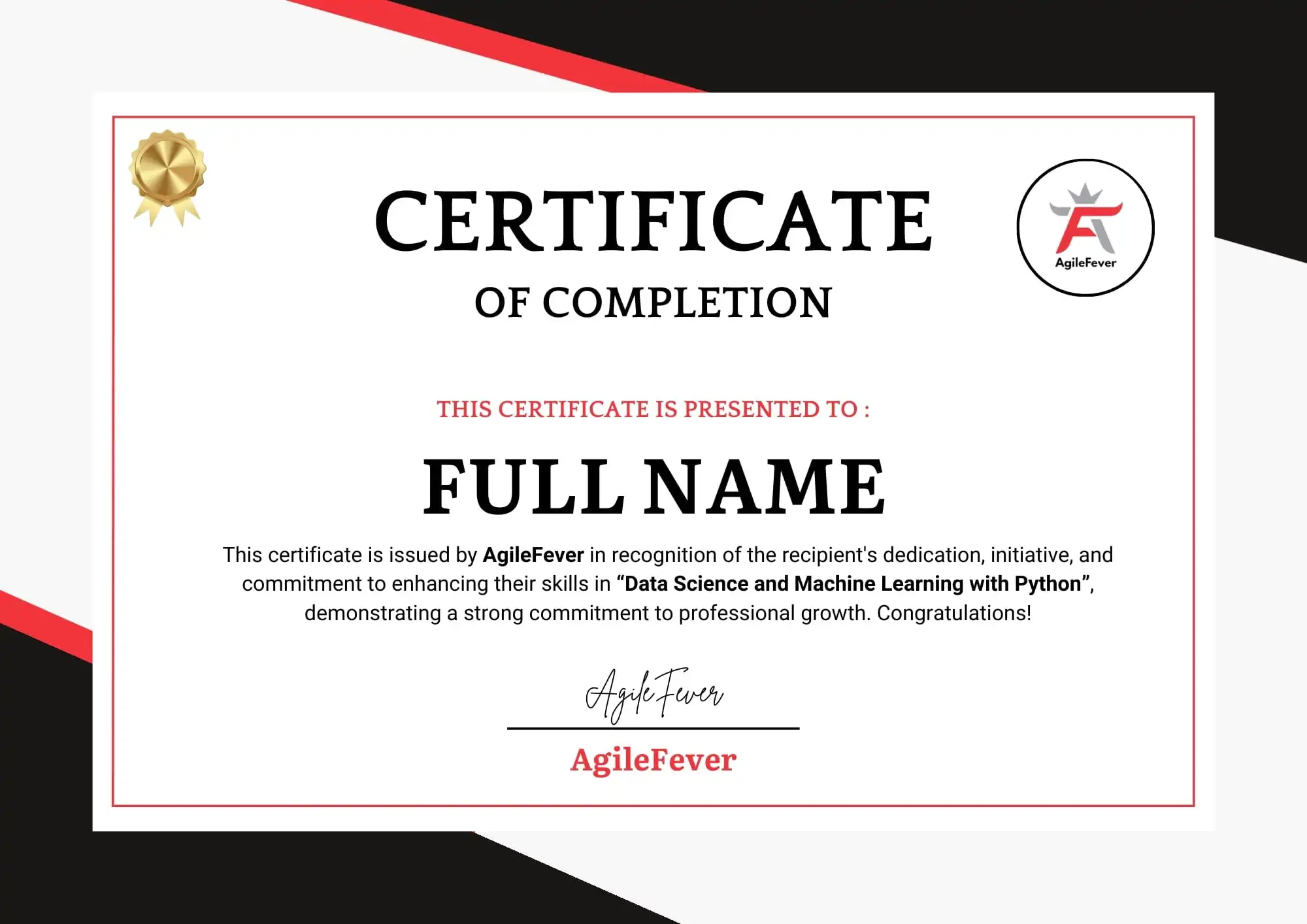
      Data-Science-and-Machine-Learning-with-Python-Training-certificate
      img

      Data Science and Machine Learning with Python is ideal for

      • Software Engineers and Developers
      • Domain Experts
      • Business and Data Analysts
      • IT Professionals
      • Statisticians and Mathematicians
      Enquire Now

      Companies that trust Us

      Happy learners and successful teams, that’s how we measure our impact. Here are just a few of the many who’ve trusted AgileFever.

      accenture-logo
      adobe-logo
      amazon-logo
      boa-logo
      dell-logo
      disney-logo
      exonmobil-logo
      google-logo
      ibm-logo
      meta-logo
      microsoft-logo
      rackspace-logo
      tesla-logo
      twilio-logo

      Benefits That Set You Apart

      trained
      trained
      trained
      trained
      trained
      exp-trainers
      exp-trainers
      exp-trainers
      exp-trainers
      exp-trainers

      Steps to Getting Certified

      1 Step
      2 Step
      3 Step
      4 Step

      Journeys that keep Inspiring ✨ everyone at AglieFever

      The Data Science and Machine Learning course from Agilefever was fantastic! The trainers were very knowledgeable and provided detailed explanations with real-world examples. The course covered everything from Python basics to advanced machine-learning techniques. The certification has added great value to my resume, and I’m already using these skills at work.

      y-man-pic
      Rahul Deshmukh

      Business Intelligence Analyst

      I had an amazing experience with Agilefever’s Data Science and Machine Learning with Python training! The course was well-structured, and the instructors simply explained complex concepts. The hands-on projects were a game-changer, helping me apply what I learned in real-world scenarios. After completing the certification, I feel much more confident in my data science skills. Highly recommend it!

      lady-pic
      Sarah Mitchell

      Data Analyst

      Frequently Asked Questions

      1. What is data science and machine learning with python course?

      It’s like learning to be a data detective using Python, where you discover hidden patterns in information and teach computers to make smart guesses. You learn to work with numbers, make charts, and solve real-world problems using computer programs.

      2. How many hours is data science and machine learning with python course?
      40 hours.

      3. Which is the best institute for data science and machine learning with python training?

      According to the reviews and ratings, we can suggest AgileFever’s training program.

      4. What is data science and machine learning in Python?

      Data science is like being a number detective – you look at lots of information to find useful answers. Machine learning is teaching computers to learn from examples, like teaching a computer to recognize cats in pictures after showing it many cat photos.

      5. Which is better, AI/ML or data science?

      It’s like asking whether being a chef or a restaurant manager is better – they’re different but related jobs. Data science helps understand information, while AI/ML focuses on making smart computer programs – choose based on what interests you more.

      Ready to unlock your full potential as a Scrum Master?

      Talk to Advisor