Home AI and Data Science Advanced Machine Learning with Deep Learning

Advanced Machine Learning with Deep Learning

Enrolled 4.9/5 4.6/5 4.9/5

The Advanced Machine Learning with Deep Learning course helps you discover the potential of emerging technologies and offers practical guidance on how to implement these technologies efficiently, improve workflows, and spur innovation across various industries.

  • 32 hours of live, online, instructor-led training
  • Hands-on case study approach
  • Price match guarantee
  • Lifetime Learning Management System (LMS) access
View Schedule Download Brochure

Get Free Consultation

    50+

    Countries worldwide

    100+

    Expert Trainers

    10k+

    Professionals Trained

    4.7

    Overall Rating

    Course Overview

    Our training with Advanced Machine Learning with Deep Learning will keep specialists at the top of their game in a constantly changing tech environment. Important concepts like deep learning, AI, and machine learning are covered. This course equips learners to develop and implement advanced AI solutions, enabling them to drive innovation and optimise processes in their fields. This training provides hands-on experiences, increases productivity, and improves decision-making.

    Key Highlights

    Comprehensive training in advanced ML and AI.

    Hands-on learning with real-world case studies.

    Taught by expert instructors in live sessions.

    Lifetime LMS access for flexible learning.

    In-demand skills for diverse industry applications.

    Boosts career growth and professional expertise.

    Applicable across IT, healthcare, retail, and more.

    Advanced Machine Learning with Deep Learning Course Content

    Download Syllabus
    Module 1 Foundations of Artificial Intelligence and Machine Learning
    • Introduction to Artificial Intelligence & Machine Learning
    • Overview- AI Vs ML Vs Deep Learning
    • Overview- Subfields of Artificial Intelligence- Robotics, ML, NLP, Computer Vision
    • Applications of Machine Learning/AI
    • Difference b/w AI & Programmed Machine
    • R & R Studio Setup & Installation
    • A quick tour of R-Studio – Variables, Install, Plot, help, console, repository
    • Important Links to get datasets – Kaggle, data.gov, etc
    Module 2 Object-Oriented Programming and Data Structures in R

    • Classes & Objects
    • Vector and List in R
    • Hands-on
    Module 3 Exploring Matrices and Factors in R with Hands-on Practice
    • Matrix & Factor in R
    • Hands-on
    Module 4 Data Handling and Visualization in R
    • Dataframe in R
    • Plotting using gggplot2 in R – Scatter plot, Box plot, Hist, Bar chart, etc
    • N-Dimensional Array in R
    • Table function in R
    • Hands-on
    Module 5 Data Analysis and Integration with R
    • Statistics in R – Mean, Median, Mode, Range, Variance, SD, Inter Quartile
    • Twitter- R Integration
    • Get data from MySQL using R
    • Get data from the website using the R
    • Hands-on
    Module 6 Preparing and Preprocessing Data for Machine Learning
    • Steps involved in solving a Machine Learning Usecase
    • Data preprocessing/preparation in R
    • Missing data, Categorical data, Feature Scaling, Splitting data to test & train sets
    • Hands-on with sample data
    Module 7 Introduction to Machine Learning and Hands-on Model Building
    • Types of Machine Learning- Supervised & UnSupervised Machine Learning
    • Supervised Learning – Regression & Classification
    • UnSupervised Learning- Clustering
    • Regression Algorithm- Simple Linear Regression
    • UseCase: Create a Model to predict Salary from years of exp
    • Classification Algorithm- K Nearest Neighbour
    • UseCase: Create a Model to predict if a particular customer will purchase a product or not
    • Hands-on with Sample data
    Module 8 Clustering Techniques and Customer Data Analysis
    • Clustering Algorithm- Kmeans
    • Elbow Method in Kmeans to predict optimal no. of Clusters
    • Clustering Algorithm- Hierarchical Clustering
    • Dendograms in Hierarchical Clustering to Predict Optimal No. of Cluster
    • UseCase: Using Kmeans & HC to extract patterns to analyse customer data based on spending score and income
    • Hands-on with Sample data
    Module 9 Building and Evaluating Predictive Models with Logistic Regression
    • Logistics Regression
    • UseCase: Create a Model to predict if a particular customer will purchase a product or not
    • How to create and read the ROC curve
    • How to check the accuracy of the Model using the Confusion Matrix
    • Hands-on with Sample data
    Module 10 Mastering Classification with Random Forest & SVM & Advanced Regression, Satellite Image Classification

    Mastering Classification with Random Forest

    • Random Forest using Decision Trees
    • Support Vector Machine for Classification
    • UseCase: Create a Model using Random Forest & SVM to predict if a particular customer will purchase a product or not
    • How to create and read the ROC curve
    • How to check the accuracy of the Model using the Confusion Matrix
    • Hands-on with Sample data

    Advanced Regression & Satellite Image Classification

    • Polynomial Regression
    • UseCase: Create a Model to predict Salary from years of exp
    • UseCase: Satellite Image Classification using Random Forest. Create a Model to identify/classify different types of land re.g, barren, forest, urban, river, etc. from a Satellite image
    • Hands-on with Sample data
    Module 11 Dimensionality Reduction, Model Accuracy Tuning & NLP, Sentiment Analysis with R

    Dimensionality Reduction and Model Accuracy Tuning

    • Dimensionality Reduction
    • Feature Selection Vs Feature Extraction
    • Feature Selection using the Backward Elimination technique
    • Feature Extraction using PCA
    • Hands-on with Sample data
    • How to tune/check the accuracy of the Model using P- Value, R Square, Adjusted R Square, CAP

    NLP and Sentiment Analysis with R

    • Overview of NLP/Text Mining
    • Libraries in R for NLP/text mining – tm, Snowball, dplyr
    • Bag of words using R
    • Use Case: Restaurents Review System
    • Sentiment Analaysis using R
    • Use case: Analyse Twitter data for two teams to predict sentiments
    • Hands-on with Sample data
    Module 12 Building Intelligent Recommendation Systems & Time Series Analysis, Introduction to Deep Learning

    Building Intelligent Recommendation Systems

    • Overview of types of recommendation engines – Example E-commerce, Netflix etc
    • Frequently bought items, User-Based Collaborative Filtering
    • Libraries in R for recommendation – recommended lab

    • Use Case: Analyse grocery store data to find out frequently bought together item
    • Use Case: Analyse joke data to recommend the best jokes to users
    • Hands-on with Sample data

    Time Series Analysis & Introduction to Deep Learning

    • Time Series data analysis in R
    • Components in time series – Trend, Seasonality
    • Arima Model Vs ETS Model
    • Use Case: Forecast Flight booking from Airline data
    • Sentiment Analysis using R
    • Hands-on with Sample data
    • Deep Learning Introduction
    • Limitations of ML and how Deep Learning comes to the rescue
    • Biological Neural Network Vs Artificial Neural Network
    • Popular Frameworks of Deep Learning – Tensorflow, Keras
    Module 13 Fundamentals of Deep Learning, ANN Implementation & Convolutional Neural Networks (CNN), Image Classification

    Fundamentals of Deep Learning & ANN Implementation

    • Understanding Deep Learning Terminologies – Input Layer, Hidden Layer, Output Layer, Activation Function, Cost Function, Back Propagation, Gradient Descent, Epoch, Learning Rate
    • Install Keras (using tensorflow)
    • Use Case: Create a model using ANN for Boston housing data

    Convolutional Neural Networks (CNN) & Image Classification

    • Convolutional Neural Network
    • Convolution, Polling, Flattening
    • Use Case: Image classification using CNN
    • Hands-on with Sample data
    Module 14 Case Studies

    Case Study – Predict Customer Churn

    Case Study – Canada Crime Analysis

    Module 15 Summary and Q&A

    Summary & QA

    Schedules for Advanced Machine Learning with Deep Learning

    Enquiry for Corporate Training

      I consent to AgileFever representative contacting me.

      Talk to a Learning Advisor

      To fast-track your career and achieve

      Can't find Convenient Schedule?

      Pay Monthly EMI, as low as

      $83/month
      We have partnered with the following financing companies to provide competitive finance options at as low as 0% interest rates with no hidden cost.
      payment

      Advanced Machine Learning with Deep Learning Exam Details

      Exam Details

      Name of Exam – AgileFever Advanced Machine Learning with Deep Learning Examination

      Exam details are as follows:

      • Practical Exams, Lab Assessments, and Projects at the end of every completed module.
      • Capstone Project at the end of the training.
      Prerequisites

      Anyone can register for this course.

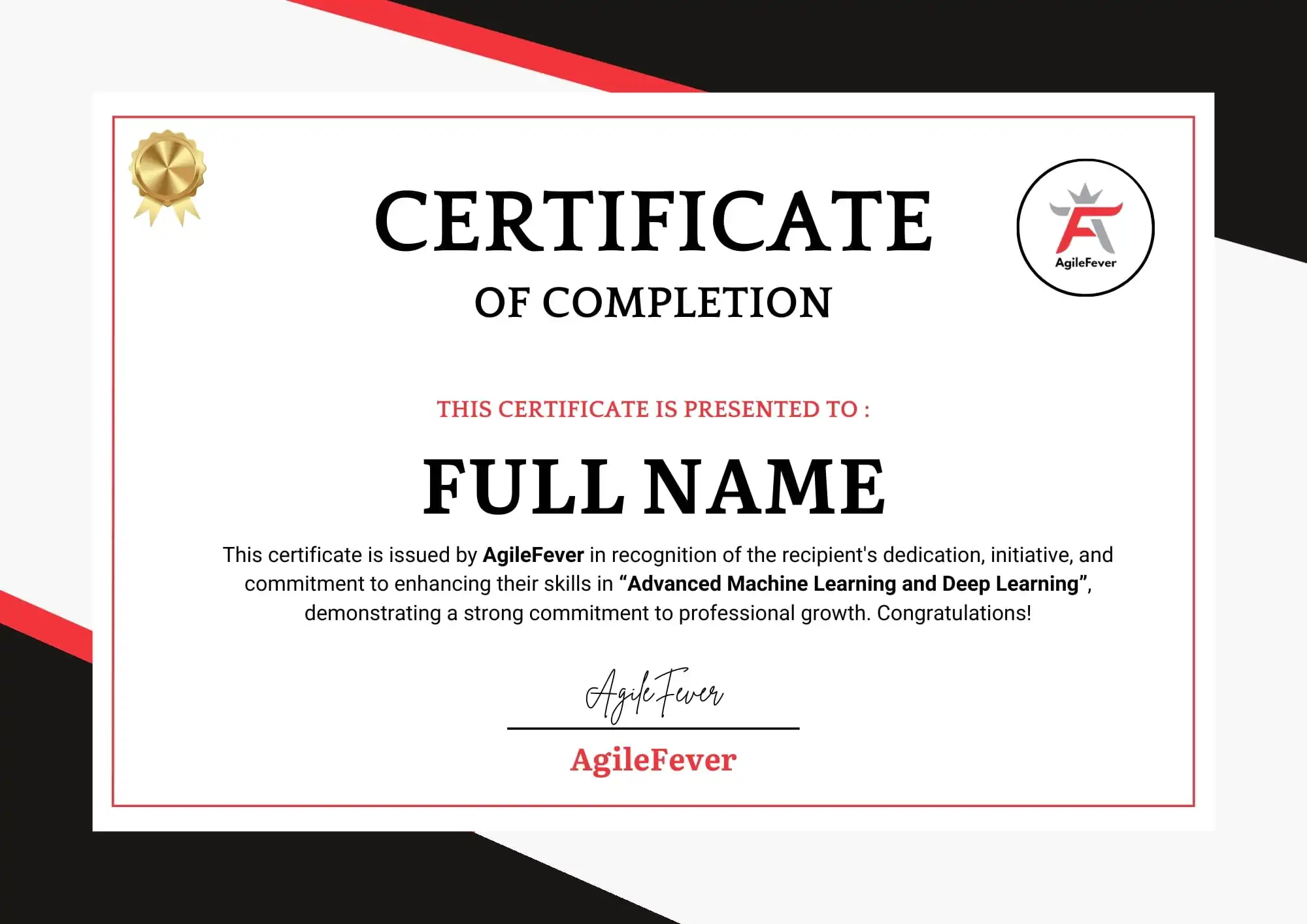
      Advanced-Machine-Learning-and-Deep-Learning-Training-certificate
      img

      Advanced Machine Learning with Deep Learning is ideal for

      • IT professionals
      • Solution architects
      • Electrical and electronic engineers
      • Entrepreneurs
      • Designers
      • Professionals from pharmaceuticals, real estate, sales, finance, designing, manufacturing, electrical, retail, and healthcare domains
      Enquire Now

      Companies that trust Us

      Happy learners and successful teams, that’s how we measure our impact. Here are just a few of the many who’ve trusted AgileFever.

      accenture-logo
      adobe-logo
      amazon-logo
      boa-logo
      dell-logo
      disney-logo
      exonmobil-logo
      google-logo
      ibm-logo
      meta-logo
      microsoft-logo
      rackspace-logo
      tesla-logo
      twilio-logo

      Benefits That Set You Apart

      exp-trainers
      exp-trainers
      exp-trainers
      exp-trainers
      exp-trainers
      exp-trainers
      exp-trainers
      exp-trainers
      exp-trainers
      exp-trainers

      Steps to Getting Certified

      1 Step
      2 Step
      3 Step
      4 Step

      Journeys that keep Inspiring ✨ everyone at AglieFever

      I took the Advanced Machine Learning with Deep Learning Training from Agilefever, and it was a fantastic experience. The course structure was well-organized, and the hands-on projects helped me understand complex concepts. The trainers were knowledgeable and explained everything clearly. Getting certified from Agilefever has boosted my confidence in applying deep learning techniques in real-world projects. Highly recommend it

      man-pic
      John

      Data Scientist

      This training was exactly what I needed to level up my deep learning skills. The course covered everything from the basics to advanced topics with real-world applications. The interactive sessions and practical exercises made learning so much easier. The certification from Agilefever added real value to my resume and helped me land better opportunities. I’m truly grateful for this course!

      lady-pic
      Emily

      AI Engineer

      This training at Agilefever exceeded my expectations. The instructors explained concepts in a simple yet effective way, making it easier to grasp even the toughest topics. The real-world case studies and assignments made a big difference in understanding deep learning applications. Getting certified from Agilefever has enhanced my skills and made me more confident in my role. A great learning experience.

      y-man-pic
      Ravi Sharma

      Machine Learning Engineer

      Frequently Asked Questions

      1. Who is this Advanced Machine Learning with Deep Learning course for?

      This course is ideal for IT professionals, engineers, data scientists, and business leaders looking to advance their AI and ML skills.

      2. Do I need prior experience in Machine Learning?

      Basic knowledge of programming and ML concepts is helpful but not mandatory, as the course starts with foundational concepts.

      3. Will I receive a certification after completing the course?

      Yes, participants receive a certification upon successful completion of the course.

      4. What is the duration of the course?

      The course is 32 hours of live, instructor-led sessions.

      5. Are there any hands-on projects included?

      Yes, the course includes real-world case studies and practical exercises.

      6. Can I access course materials after the sessions?

      Yes, you’ll have lifetime access to the Learning Management System (LMS) for all materials.

      7. What if I miss a class?

      You’ll get access to recorded sessions of the classes you missed.

      8. What industries benefit from this course?

      This course is relevant for industries like IT, healthcare, retail, finance, manufacturing, and more.

      9. Do I need specific tools or software for the course?

      You’ll need a computer with a stable internet connection. The necessary tools and platforms will be introduced during the course.

      10. How can I enrol in the course?

      You can enrol directly through the course page or contact support for assistance.

      Ready to unlock your full potential as a Scrum Master?

      Talk to Advisor