Home AI and Data Science Working with Large Language Models Training

Working with Large Language Models Training

Enrolled 4.9/5 4.6/5 4.7/5

The Working with Large Language Models training by AgileFever is tailored to deliver a thorough understanding and practical expertise in using diverse generative AI models, including Txt2Txt GenAI, Img2Img GenAI, Multimodal GenAI, and an overview of PaLM 2.

  • 40 hours of live, instructor-led training
  • Learn from experts and leaders in the Generative AI industry
  • Access 24/7 dedicated support
  • Enhance your skills through hands-on exercises and interactive lab activities
View Schedule Download Brochure

Get Free Consultation

    50+

    Countries worldwide

    100+

    Expert Trainers

    10k+

    Professionals Trained

    4.7

    Overall Rating

    Course Overview

    The Working with Large Language Models course by AgileFever is a 40-hour live training program led by top experts in the Generative AI field. Tailored for advanced learners, the course features a cutting-edge curriculum packed with expert insights, advanced strategies, interactive exercises, and lab activities, enabling participants to apply their skills right away.

    After completing this course, learners will develop a deep understanding of large language models and master their use effectively to implement Txt2Txt GenAI, Img2Img GenAI, and Multimodal GenAI. This journey from fundamental concepts to advanced skills provides learners with a thorough understanding, enabling them to utilize generative AI tools effectively in their business environments.

    Key Highlights

    Comprehensive understanding of various large language models.

    Expertise in Txt2Txt GenAI, covering topics like Seq2seq Models and GPT Fundamentals.

    Practical experience with Img2Img GenAI, including training GANs and using Auto-Encoders in Keras.

    Insights into Multimodal GenAI, featuring CLIP Drop and Stable Diffusion techniques.

    Advanced knowledge of PaLM 2, focusing on the Pathway Language Model journey and using the PaLM API in Vertex AI.

    Working with Large Language Models Training Course Content

    Download Syllabus
    Module 1: Introduction to Txt2txt Gen AI
    • Overview of Txt2Txt GenAI.
    • Introduction to Unimodal Mappings.
    • Understanding the Significance of Txt2Txt GenAI in AI.

    Lab:

    • Hands-on session: Exploring the basics of Txt2Txt GenAI.
    • Interactive exercises: Working with unimodal mappings.
    Module 2: Exploring statistical and Neural Language Models
    • Introduction to Statistical Language Models.
    • Exploring the Applications of Statistical Language Models.
    • Hands-on Experience with Statistical Language Models.
    • Overview of Neural Language Models.
    • Deep Dive into the Architecture of Neural Language Models.
    • Exploring the Applications of Neural Language Models.

    Lab:

    • Hands-on workshop: Working with Statistical Language Models.
    • Interactive exercises: Experimenting with various Statistical Language Models.
    • Hands-on session: Working with Neural Language Models.
    • Interactive exercises: Understanding the architecture of Neural Language Models.
    Module 3: SLM and PLM in Python and Keras
    • Introduction to SLM and PLM in Python and Keras.
    • Exploring the Implementation of SLM and PLM.
    • Hands-on Experience with SLM and PLM in Python and Keras.

    Lab:

    • Hands-on workshop: Implementing SLM and PLM using Python and Keras.
    • Interactive exercises: Working with SLM and PLM in practical scenarios.
    Module 4: Deep Dive into Seq2seq Models
    • Comprehensive Overview of Seq2seq Models.
    • Exploring the Architecture and Functionality of Seq2seq Models.
    • Real-World Applications of Seq2seq Models.

    Lab:

    • Hands-on session: Working with Seq2seq Models.
    • Interactive exercises: Exploring the applications of Seq2seq Models.
    Module 5: Exploring Hugging Face Transformer Pipelines
    • Introduction to Hugging Face Transformer Pipelines.
    • Exploring the Functionality and Implementation of Transformer Pipelines.
    • Hands-on Experience with Hugging Face Transformer Pipelines.

    Lab:

    • Hands-on workshop: Implementing Hugging Face Transformer Pipelines.
    • Interactive exercises: Working with Transformer Pipelines in AI tasks.
    Module 6: LLM Transfer Learning in NLP
    • Introduction to Transfer Learning in NLP.
    • Exploring the Applications of Transfer Learning in NLP.
    • Hands-on Experience with Transfer Learning in NLP.

    Lab:

    • Hands-on workshop: Implementing Transfer Learning in NLP.
    • Interactive exercises: Working with Transfer Learning in practical scenarios.
    Module 7: GPT Fundamentals: GPT 3.5 vs GPT 4
    • Comprehensive Overview of GPT Fundamentals.
    • Exploring the Differences between GPT3.5 and GPT4.
    • Understanding the Advancements in GPT4.

    Lab:

    • Hands-on session: Working with GPT3.5 and GPT4.
    • Interactive exercises: Exploring the advancements in GPT4.
    Module 8: ChatGPT and OpenAI API, ChatGPT Clone in Google Colab and Streamlit
    • Introduction to ChatGPT and OpenAI API.
    • Exploring the Functionality and Implementation of ChatGPT and OpenAI API.
    • Hands-on Experience with ChatGPT and OpenAI API.
    • Introduction to ChatGPT Clone in Google Colab and Streamlit.
    • Exploring the Implementation of ChatGPT Clone.
    • Hands-on Experience with ChatGPT Clone in Google Colab and Streamlit.

    Lab:

    • Hands-on workshop: Implementing ChatGPT and OpenAI API.
    • Interactive exercises: Working with ChatGPT and OpenAI API in AI tasks.
    • Hands-on workshop: Implementing ChatGPT Clone using Google Colab and Streamlit.
    • Interactive exercises: Working with ChatGPT Clone in practical scenarios.
    Module 9: Introduction to lmg2lmg Gen AI
    • Overview of Img2Img GenAI.
    • Introduction to Auto-Encoder Visualization.
    • Understanding the Significance of Img2Img GenAI in AI.

    Lab:

    • Hands-on session: Exploring the basics of Img2Img GenAI.
    • Interactive exercises: Working with Auto-Encoder visualization.
    Module 10: Exploring Variational Auto-Encoder and Coding AE in Keras
    • Introduction to Variational Auto-Encoder.
    • Exploring the Applications of Variational Auto-Encoder.
    • Hands-on Experience with Variational Auto-Encoder.
    • Introduction to Coding AE in Keras.
    • Exploring the Implementation of AE in Keras.
    • Hands-on Experience with Coding AE in Keras.

    Lab:

    • Hands-on workshop: Working with Variational Auto-Encoder.
    • Interactive exercises: Experiment with various Variational Auto-Encoder.
    • Hands-on workshop: Implementing AE using Keras.
    • Interactive exercises: Working with AE in practical scenarios.
    Module 11: Training GANs and Multimodal Gen AI
    • Comprehensive Overview of Training GANs.
    • Exploring the Architecture and Functionality of GANs.
    • Real-World Applications of Training GANs.
    • Introduction to Multimodal GenAI.
    • Exploring Multimodal Txt2Img Generation.
    • Understanding Latent Diffusion Models.

    Lab:

    • Hands-on session: Working with Training GANs.
    • Interactive exercises: Exploring the applications of Training GANs.
    • Hands-on workshop: Implementing Multimodal GenAI.
    • Interactive exercises: Working with Multi-modal Txt2Img Generation and Latent Diffusion Models.
    Module 12: Exploring CLIP Drop and Stable Diffusion, Leaonardo AI, Midjourney, and OpenAI
    • Introduction to CLIP drop and Stable Diffusion.
    • Exploring the Applications of CLIP Drop and Stable Diffusion.
    • Hands-on Experience with CLIP drop and Stable Diffusion.
    • Comprehensive Overview of LeonardoAI, Midjourney, and OpenAPI – Dall-E3.
    • Exploring the Architecture and Functionality of LeonardoAI, Midjourney, and OpenAPI – Dall-E3.
    • Real-World Applications of LeonardoAI, Midjourney, and OpenAPI – Dall-E3.

    Lab:

    • Hands-on workshop: Implementing CLIP drop and Stable Diffusion.
    • Interactive exercises: Working with CLIP drop and Stable Diffusion in practical scenarios.
    • Hands-on session: Working with LeonardoAI, Midjourney, and OpenAPI – Dall-E3.
    • Interactive exercises: Exploring the applications of LeonardoAI, Midjourney, and OpenAPI – Dall-E3.
    Module 13: Txt2Voice Generation and Palm2
    • Introduction to Txt2Voice Generation – Evenlabs.
    • Exploring the Functionality and Implementation of Txt2Voice Generation – Evenlabs.
    • Hands-on Experience with Txt2Voice Generation – Evenlabs.
    • Overview of PaLM 2.
    • Introduction to Pathway Language Model Journey.
    • Understanding the Significance of PaLM 2 in AI.

    Lab:

    • Hands-on workshop: Implementing Txt2Voice Generation – Evenlabs.
    • Interactive exercises: Working with Txt2Voice Generation – Evenlabs in AI tasks.
    • Hands-on session: Exploring the basics of PaLM 2.
    • Interactive exercises: Working with Pathway Language Model Journey.
    Module 14: Exploring Bard and PaLM API in Vertex API
    • Introduction to Bard and PaLM API.
    • Exploring the Applications of Bard and PaLM API.
    • Hands-on Experience with Bard and PaLM API.
    • Introduction to PaLM API in Vertex AI.
    • Exploring the Applications of PaLM API in Vertex AI.
    • Hands-on Experience with PaLM API in Vertex AI.

    Lab:

    • Hands-on workshop: Implementing Bard and PaLM API.
    • Interactive exercises: Working with Bard and PaLM API in practical scenarios.
    • Hands-on workshop: Implementing PaLM API in Vertex AI.
    • Interactive exercises: Working with PaLM API in Vertex AI in practical scenarios.
    Module 15: Introduction to MakerSuite
    • Overview of MakerSuite.
    • Introduction to the functionalities of MakerSuite.
    • Understanding the Significance of MakerSuite in AI.
    • Introduction to Advanced Features of MakerSuite.
    • Exploring the Applications of Advanced Features in MakerSuite.
    • Hands-on Experience with Advanced Features of MakerSuite.

    Lab:

    • Hands-on workshop: Working with Advanced Features in MakerSuite.
    • Interactive exercises: Experimenting with various Advanced Features in MakerSuite.

    Schedules for Working with Large Language Models Training

    Enquiry for Corporate Training

      I consent to AgileFever representative contacting me.

      Talk to a Learning Advisor

      To fast-track your career and achieve

      Can't find Convenient Schedule?

      Pay Monthly EMI, as low as

      $75/month
      We have partnered with the following financing companies to provide competitive finance options at as low as 0% interest rates with no hidden cost.
      payment

      Working with Large Language Models Training Exam Details

      Exam Details

      Name of Exam – AgileFever Gen AI Working with Large Language Models Exam

      Exam details are as follows:

      • Practical Exams, Lab Assessments, and Projects at the end of every completed module.
      Prerequisites
      • Knowledge of Machine Learning concepts
      • Fundamentals of Deep Learning
      • Experience with Natural Language Processing (NLP) techniques
      • Proficiency in programming
      • Practical experience with data handling
      • Strong foundation in mathematics
      • Understanding of hardware requirements
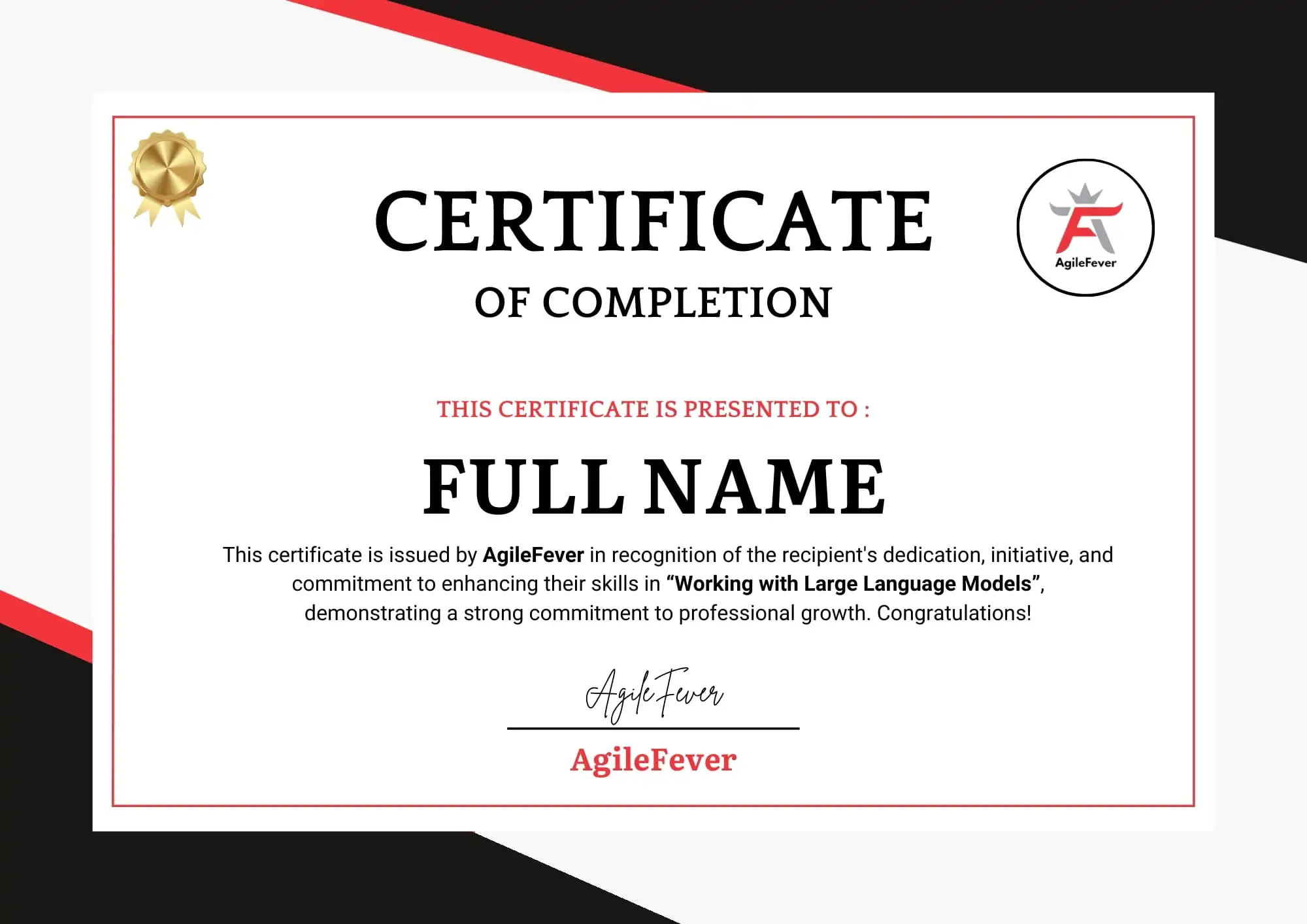
      Working-with-Large-Language-Models-Training-certificate
      img

      Working with Large Language Models Training is ideal for

      • Data Scientists
      • AI Enthusiasts
      • Software Developers
      • Machine Learning Engineers
      • Project Leads
      • Entrepreneurs
      Enquire Now

      Companies that trust Us

      Happy learners and successful teams, that’s how we measure our impact. Here are just a few of the many who’ve trusted AgileFever.

      accenture-logo
      adobe-logo
      amazon-logo
      boa-logo
      dell-logo
      disney-logo
      exonmobil-logo
      google-logo
      ibm-logo
      meta-logo
      microsoft-logo
      rackspace-logo
      tesla-logo
      twilio-logo

      Benefits That Set You Apart

      exp-trainers
      exp-trainers
      exp-trainers
      exp-trainers
      exp-trainers
      exp-trainers
      exp-trainers

      Steps to Getting Certified

      1 Step
      2 Step
      3 Step
      4 Step

      Journeys that keep Inspiring ✨ everyone at AglieFever

      This course on Working with Large Language Models exceeded my expectations! The instructors were industry experts who broke down complex concepts into easy-to-understand lessons. The hands-on exercises and interactive labs gave me practical experience with tools like Txt2Txt GenAI, Img2Img GenAI, and PaLM 2. I now feel confident applying generative AI techniques to real-world problems in my business. Highly recommended for anyone looking to master Gen AI.

      lady-pic
      Ella Mendez

      NLP Expert

      The Working with Large Language Models course from AgileFever was an incredible learning experience. The content was thorough, covering everything from foundational concepts to advanced techniques. The practical labs were especially helpful in applying what I learned. I now have a deep understanding of generative AI tools like GPT, Img2Img GenAI, and PaLM 2, and I’m already implementing them in my projects. A must-take for anyone serious about AI

      lady-pic
      Julia Davis

      NLP Expert

      I can’t recommend this course enough! The trainers were experts who made complex topics like deep learning and multimodal GenAI accessible. The hands-on sessions with tools like Keras and Vertex AI helped me gain the confidence to integrate these technologies into my work. This course gave me the skills I need to stay ahead in the rapidly evolving field of AI

      man-pic
      Miles Johnson

      Project Lead

      Frequently Asked Questions

      1. How will the Gen AI Working with Large Language Models course help me?

      The Gen AI – Working with Large Language Models course by AgileFever will help you by:

      • Deepening your understanding of large language models and generative AI technologies.
      • Equipping you with practical skills in implementing Txt2Txt GenAI, Img2Img GenAI, and Multimodal GenAI.
      • Providing hands-on experience with cutting-edge tools like PaLM 2, GPT, and GANs, which you can apply directly to real-world problems.
      • Enhancing your problem-solving abilities with advanced techniques, enables you to innovate and optimize AI applications.
      • Expanding your career opportunities by mastering in-demand AI skills that are highly valued across industries
      2. What are the job roles I can apply for after completing the Working with Large Language Models course?

      After completing the Gen AI – Working with Large Language Models course, you can apply for various job roles, including:

      • AI/ML Engineer
      • Data Scientist
      • Generative AI Specialist
      • Natural Language Processing (NLP) Engineer
      • Machine Learning Researcher
      • AI Solutions Architect
      • AI Application Developer
      • Deep Learning Engineer
      • Data Engineer
      • AI Product Manager
      • AI Consultant

      These roles are highly sought after in industries such as tech, finance, healthcare, and e-commerce, where advanced AI technologies are being integrated into products and services.

      3. Which industries use Large Language Models?

      Professionals who specialize in Large Language Models experience a huge demand across a variety of industries such as – IT, Retail, Manufacturing, Energy, Aerospace, Sports, Hospitality, e-commerce, and more.

      4. What is the duration of the Working with Large Language Models course?

      AgileFever’s 40-hour Working with Large Language Models course, led by industry experts, offers a comprehensive curriculum with hands-on exercises and case studies. This immersive learning experience equips you with the skills to excel in the field of AI.

      5. Who are the instructors of the Working with Large Language Models course by AgileFever?

      The instructors of this course are globally renowned Gen AI experts.

      6. Is there any prerequisite to attend the Working with Large Language Models course by AgileFever?

      To attend the Working with Large Language Models course by AgileFever, you need to:

      • Knowledge of Machine Learning concepts
      • Fundamentals of Deep Learning
      • Experience with Natural Language Processing (NLP) techniques
      • Proficiency in programming
      • Practical experience with data handling
      • Strong foundation in mathematics
      • Understanding of hardware requirements
      7. What are the topics covered in this Working with Large Language Models course by AgileFever?

      This course is powered by an industry-best curriculum and interactive lab activities to strengthen your fundamentals and skills.

      Here are some of the topics covered in this course:

      • Txt2Txt Gen AI
      • Statistical and Neural Language Models
      • SLM and PLM in Python and Keras
      • Seq2seq Models
      • Hugging Face Transformer Pipelines
      • Transfer Learning in NLP
      • GPT Fundamentals and ChatGPT clones
      • Img2img GenAI
      • Variational Auto-Encoder, Coding AE in Keras
      • GANs and Multimodal GenAI
      • Txt2Voice Generation
      • PaLM2 and PaLM API
      • Advanced MakerSuite
      8. Who is the Working with Large Language Models course ideal for?

      The Working with Large Language Model training by AgileFever is ideal for:

      • AI Enthusiasts looking to enhance their knowledge of generative AI technologies.
      • Data Scientists and Machine Learning Engineers aiming to expand their expertise in advanced AI models.
      • Software Developers interested in integrating generative AI capabilities into applications.
      • Tech Leaders and Innovators seeking to leverage AI for business transformation.
      • Students and Researchers exploring cutting-edge advancements in generative AI.
      • Business Professionals wanting to apply generative AI solutions in real-world scenarios.
      9. What does corporate use Large Language Models for?

      Corporates use Large Language Models (LLMs) for a variety of purposes, including:

      • Customer Support: Automating responses and chatbots for 24/7 customer service.
      • Content Creation: Generating blog posts, marketing copy, social media content, and more.
      • Data Analysis: Analyzing large amounts of unstructured data like customer feedback, emails, and reviews.
      • Automation: Streamlining repetitive tasks such as data entry, document processing, and report generation.
      • Personalization: Offering personalized recommendations and improving user experiences through tailored content.
      • Business Intelligence: Extracting insights from vast data sources to aid decision-making.
      • Translation and Localization: Assisting in real-time language translation and content localization for global audiences.
      • Internal Communication: Enhancing internal knowledge sharing through automated documentation, FAQs, and summarization tools.
      • Sentiment Analysis: Gauging customer sentiment and opinions from social media or product reviews.

      By leveraging LLMs, businesses can improve efficiency, enhance customer experience, and drive innovation.

      10. What is the future of LLM experts?

      The future of NLP experts is incredibly promising. As NLP technology continues to advance, skilled professionals in this field will be in high demand. Here’s a glimpse into what the future holds for NLP experts:

      1. Expanding Applications:

      • Healthcare: NLP can analyze medical records, research papers, and clinical trials to accelerate drug discovery and improve patient care.
      • Finance: NLP can analyze financial news, reports, and social media sentiment to inform investment decisions and risk assessment.
      • Education: NLP can personalize learning experiences, automate grading, and provide intelligent tutoring systems.
      • Customer Service: NLP-powered chatbots and virtual assistants can enhance customer support, automate routine tasks, and improve customer satisfaction.

      2. Evolving Role:

      • Ethical Considerations: NLP experts will need to address ethical concerns related to bias, privacy, and the potential misuse of AI.
      • Interdisciplinary Collaboration: Successful NLP projects will require collaboration with experts from various fields, such as linguistics, computer science, and domain-specific knowledge.
      • Lifelong Learning: The rapid pace of technological advancement necessitates continuous learning and upskilling to stay ahead of the curve.

      3. High Demand and Lucrative Careers:

      As NLP becomes increasingly integrated into various industries, the demand for skilled NLP professionals will continue to grow. This translates into lucrative career opportunities and the potential for significant impact.

      In conclusion, the future of NLP experts is bright. By staying updated with the latest advancements, embracing interdisciplinary collaboration, and addressing ethical considerations, NLP professionals can shape the future of technology and make a lasting impact on society.

      Ready to unlock your full potential as a Scrum Master?

      Talk to Advisor